


Collision Between a Motor Yacht and a Sailing Yacht Near the Edge of Italian Territorial Waters — Technical Evidence, Forum Strategy, and a Secured Settlement
Context: an offshore impact and the immediate “who decides” problem
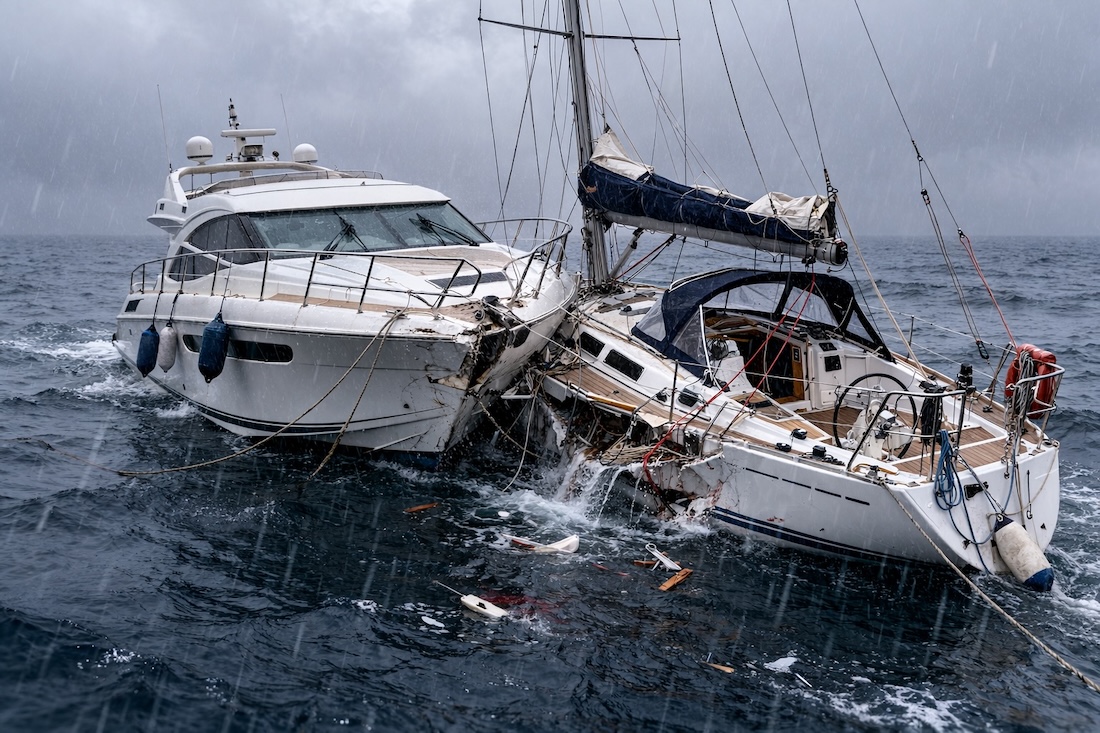
In an offshore incident that occurred a short distance from the outer limit of Italian territorial waters, a motor yachtcollided with a sailing yacht. The impact caused significant structural damage and required emergency maneuvers to secure the crew and stabilize both vessels. After initial assistance at sea, the boats were brought to a port of refuge for safety checks, temporary measures, and early inspections.
From the first hours, the case raised the typical complexities of “borderline” maritime incidents: the dynamics were disputed and, crucially, the proximity to the 12-mile line immediately triggered questions of jurisdiction and applicable law (different flags, foreign insurers, and a subsequent call in Italy). On the liability side, the technical-legal framework centered on the COLREG rules—proper lookout, safe speed, right-of-way, timely and effective avoiding action—and on the possibility of apportionment if contributory fault emerged. Operationally, the urgent goal was to avoid a slow, high-friction cross-border dispute while repair costs and loss-of-use exposure kept growing.
Our intervention: locking in evidence and securing recovery before the counterparty could leave
Our firm handled the matter as an emergency operation with two immediate objectives: preserve perishable evidenceand secure the claim.
On the evidence side, we rapidly collected and organized objective materials: AIS/GPS tracks, onboard logs and instrumentation data, weather/sea conditions, radio communications, photographs and video of the damage, crew and witness statements, and documentation from the port and assistance providers. In parallel, we coordinated a technical assessment with marine surveyors to reconstruct the collision—impact angles, trace compatibility, maneuver timing, sighting distance, and the parties’ conduct in the minutes before impact—so the case did not turn into a “story versus story” dispute but into a verifiable, court-usable reconstruction.
Strategically, we built the file around forum and security. Once we confirmed that the counterparty would call at an Italian port, we focused on enforceability: we opened rapid channels with the relevant insurers (hull and liability, where applicable), issued structured notices and demands, and—most importantly—moved to obtain real security for the claim, preventing the classic cross-border risk of a vessel departing and leaving recovery uncertain or disproportionately expensive. Our position was grounded on the COLREG breaches supported by the technical reconstruction and on the need for a solution that was fast and “bankable.”
The approach worked. The strength and clarity of the technical evidence drove meaningful engagement from the counterparty and insurers, cutting off delay tactics. The dispute closed through a settlement backed by concrete security, covering the material damage and the main economic consequences of the incident, including loss-of-use impacts linked to technical downtime.
In short, an event that could have escalated into a complex cross-border litigation was converted into a controlled path: early evidence, enforceable procedure choices, and a result that was actually collectible.
Confidentiality note: identifying details have been omitted/modified. Outcomes depend on individual circumstances and authority assessment.